
Closed beta
Keep one set of records. Answer to five frameworks.
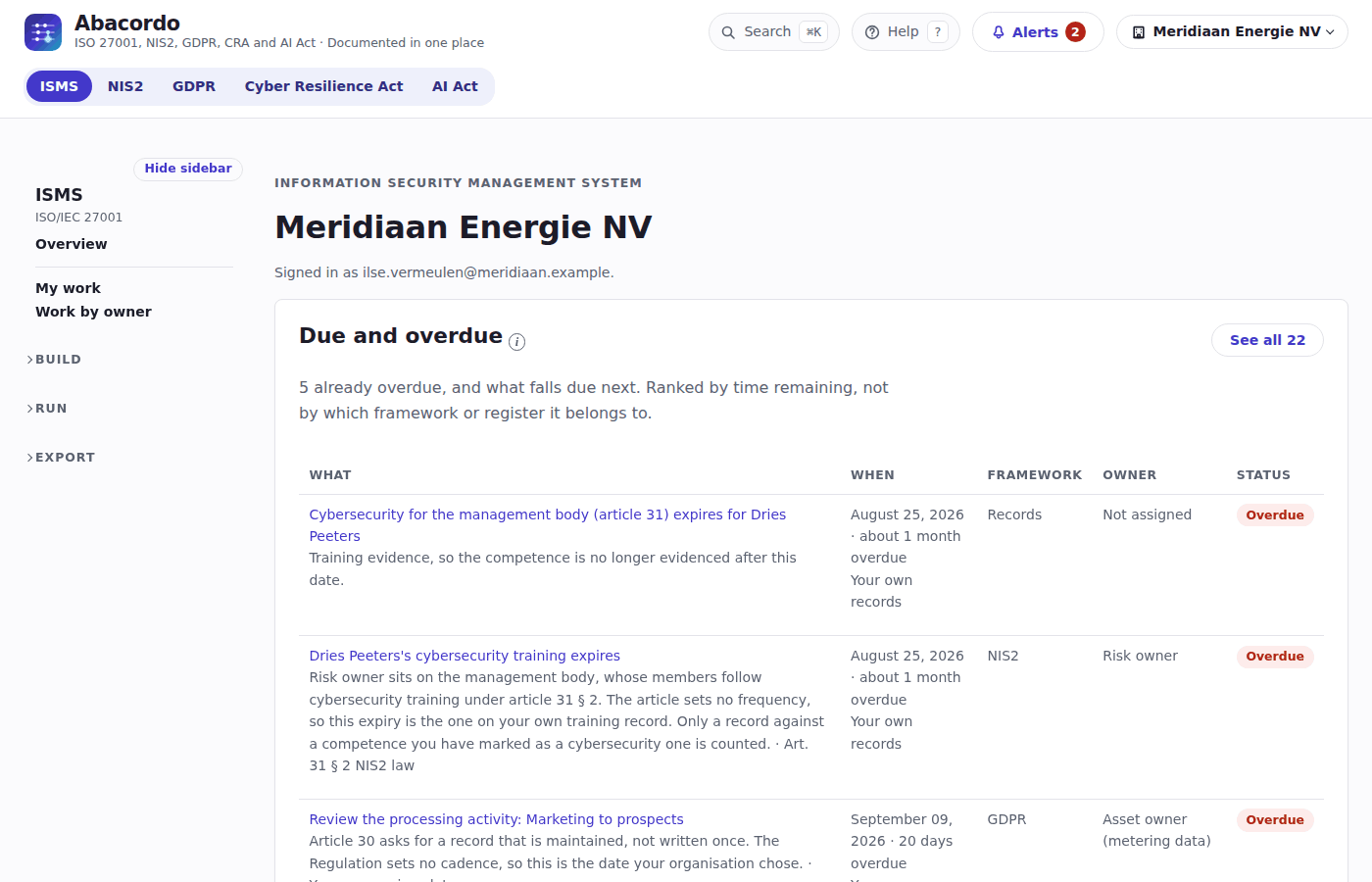
Management systems drift apart quietly. The asset register says one thing, the risk assessment says another, and the impact assessment was written before either of them. Abacordo holds the facts once and lets ISO 27001, NIS2, GDPR, the Cyber Resilience Act and the AI Act each ask their own questions of them. Change a server, and the risk that names it, the control that treats it, the processing activity that runs on it and the product it ships in all know.
There is a real CMDB underneath, not a folder of documents about one, and your Microsoft directory can keep it honest.
- Built in Belgium
- Reads in English, Dutch and French
- Works with your own AI assistant
- Reads Microsoft Entra, Intune and Active Directory
Your AI, inside your management system
Ask your own assistant to do the paperwork
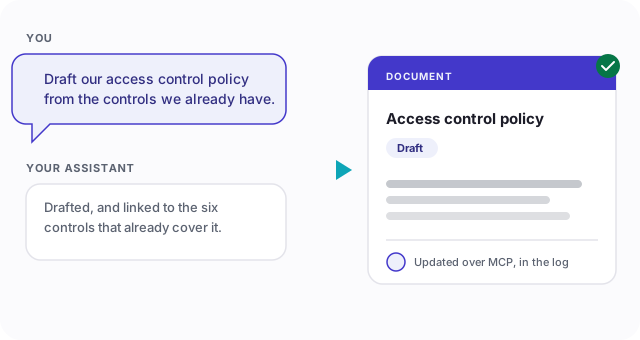
Every organisation on Abacordo gets its own address for the Model Context Protocol. Add it to Claude, ChatGPT or whichever assistant you already use, approve the connection once, and it can work in your management system directly. Not a chat window bolted onto the side of the product: the same records, the same permissions, the same audit trail.
So you can ask it things like:
- Here is our server inventory. Load it into the CMDB with the hosting relationships.
- Which of our information assets still have no owner?
- Draft an access control policy from the controls we have already implemented, and link it to them.
- Is this incident significant under NIS2, and what does it still owe?
- Where are we on the NIS2 journey, and what is the next step?
It loads a whole register in one call, links included, and is told which row failed and why. It drafts a policy into the editor as headings, lists and tables, mentioning the records it cites. It files the evidence a record rests on. And each framework's journey is a prompt it can offer you by name, so the walk through NIS2 or the AI Act happens in the conversation you are already having.
It is your assistant, not ours. We hold none of your API keys and make no model choice on your behalf.
Five frameworks, one record set
The same facts, asked about five different ways
A server, a supplier, an incident, a product you place on the market, an AI system you deploy. ISO 27001, NIS2, GDPR, the Cyber Resilience Act and the AI Act all want to know about them, and each wants to know something slightly different. Abacordo records the fact once and lets all five ask, so keeping one framework current is most of the work of keeping the next one current too.
- ISO/IEC 27001 The management system
- Clauses 4 to 10 as a working system rather than a binder: context and scope, a risk method that is yours, the Statement of Applicability against the 93 Annex A controls, policies with a versioned lifecycle, objectives, competence and awareness with the evidence behind them, internal audits, management review and corrective action. Kept current as you work, and exported as an audit package when the auditor asks.
- NIS2, in Belgium Law of 26 April 2024, CCB conformity scheme
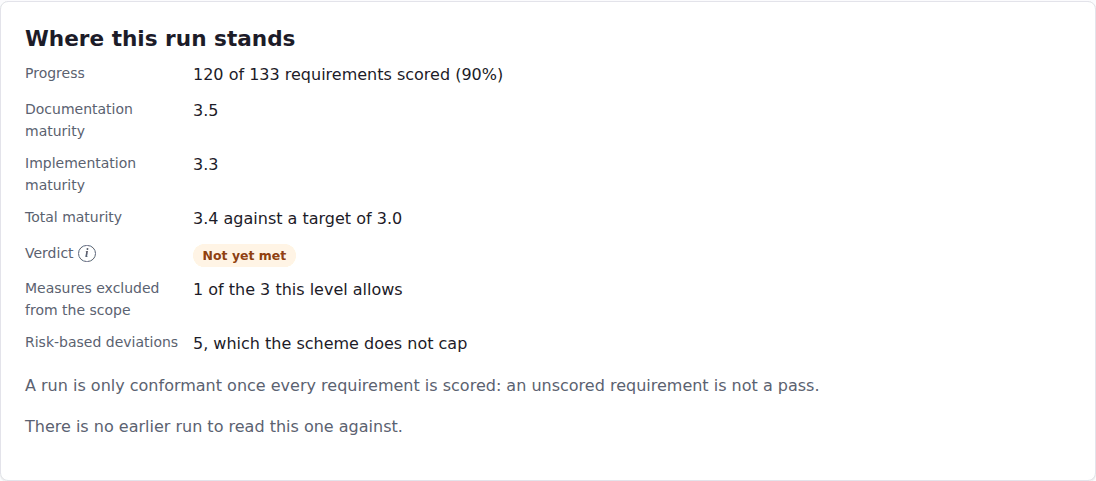
- An entity profile that reads articles 3, 9 and 10 for you, your registration with the Centre for Cybersecurity Belgium, the significance test and the notification clocks, article 30's measure domains and article 31's duties on the management body. The CyberFundamentals catalogue at your assurance level, scored on both maturity scales, evidenced from the records you already keep and frozen into a dated self-assessment when you are ready to claim it. A documentation set for your level, drafted from what you have recorded, in Dutch, French or English. The evidence package a conformity assessment body reads.
- GDPR Regulation (EU) 2016/679, Belgian law of 30 July 2018
- Both registers article 30 asks for, the retention schedule, the article 28 terms answered one by one on each processor, transfers with their chapter V ground, impact assessments with the screening behind each, a log of data subject requests with the article 12(3) clock running from receipt, and the breach assessment on the same incident record your NIS2 clocks run on. The article 5 principles and article 32 security are read from what you already hold rather than asserted.
- Cyber Resilience Act Regulation (EU) 2024/2847
- The products with digital elements you make, import or distribute, their components and releases from an imported SBOM, the vulnerabilities found in them with the article 14 actively-exploited test and the clocks it starts, a severity test on incidents, the Annex I coverage, the conformity route, and the Annex VII technical documentation and EU declaration of conformity as exports. The article 14 reporting duty, binding from 11 September 2026, was built first: it is the first duty that binds a manufacturer.
- AI Act Regulation (EU) 2024/1689, as amended by Regulation (EU) 2026/1744 (the Digital Omnibus on AI)
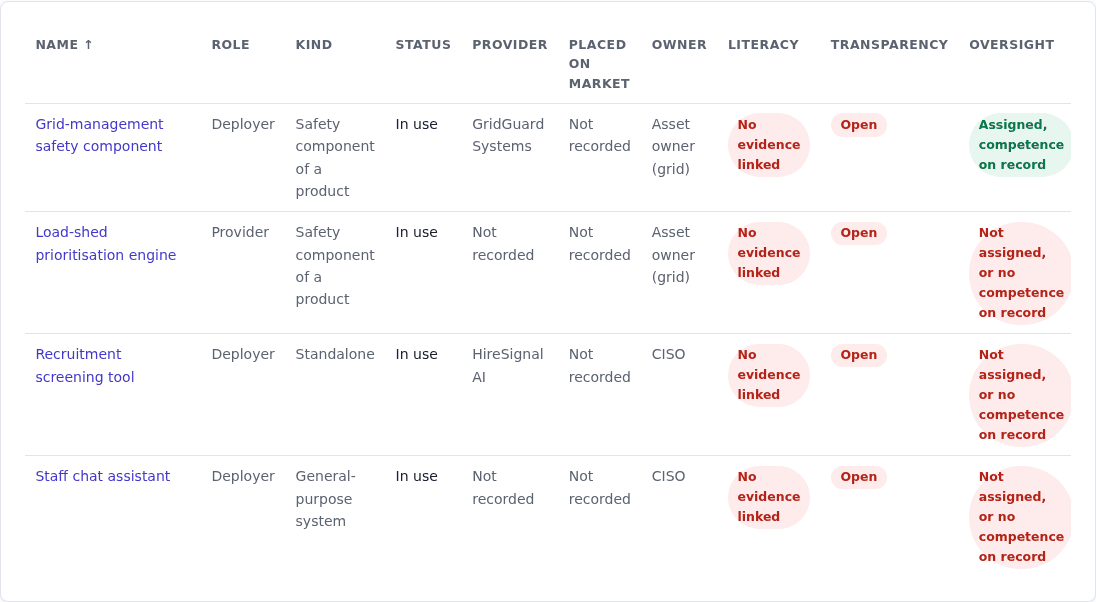
- The AI systems you provide, deploy, import or distribute, each with its article 5 screening against the prohibited practices and its classification against Annexes I and III. The duties that already bind every provider and deployer, the article 5 prohibitions, AI literacy and transparency, are checked today, and the article 73 serious-incident clock runs on the same incident record as the other three regimes. For a high-risk system, the requirement statements, the fundamental rights impact assessment on the DPIA's own shape and the conformity route are ready ahead of the date Chapter III reaches it, from 2 December 2027 for Annex III systems.
A guided route through each framework
Every framework is a journey with a next step
Each framework has a journey: the stages from "does this bind us" to "the evidence is in", built on the regulator's own guidance where there is one. The NIS2 journey is built on the CCB's "NIS2 in 7 steps"; the GDPR journey carries the Belgian data protection authority's 13 steps. Each stage says what the law or the standard asks, what to do in the company and how to record it here, and reads where you stand from your records, so the journey is never a checklist somebody ticked in a meeting.
- ISO/IEC 27001 in 11 stages, from the decision to run a management system to the certificate
- NIS2 in 11, from the scope test to the evidence a conformity assessment body reads
- GDPR in 12, from "who are we under the Regulation" to demonstrating it
- Cyber Resilience Act in 11, from whether the Regulation binds you to keeping the product in conformity
- AI Act in 12, from the role you hold to the serious-incident duty
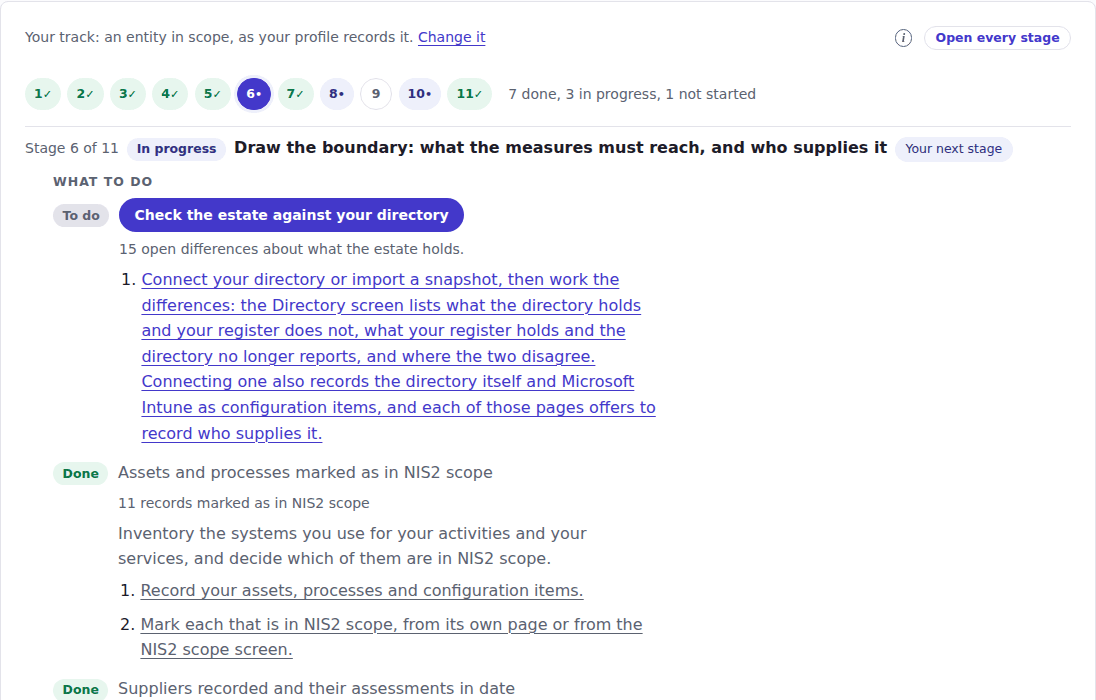
The estate: the CMDB, the link graph and your directory
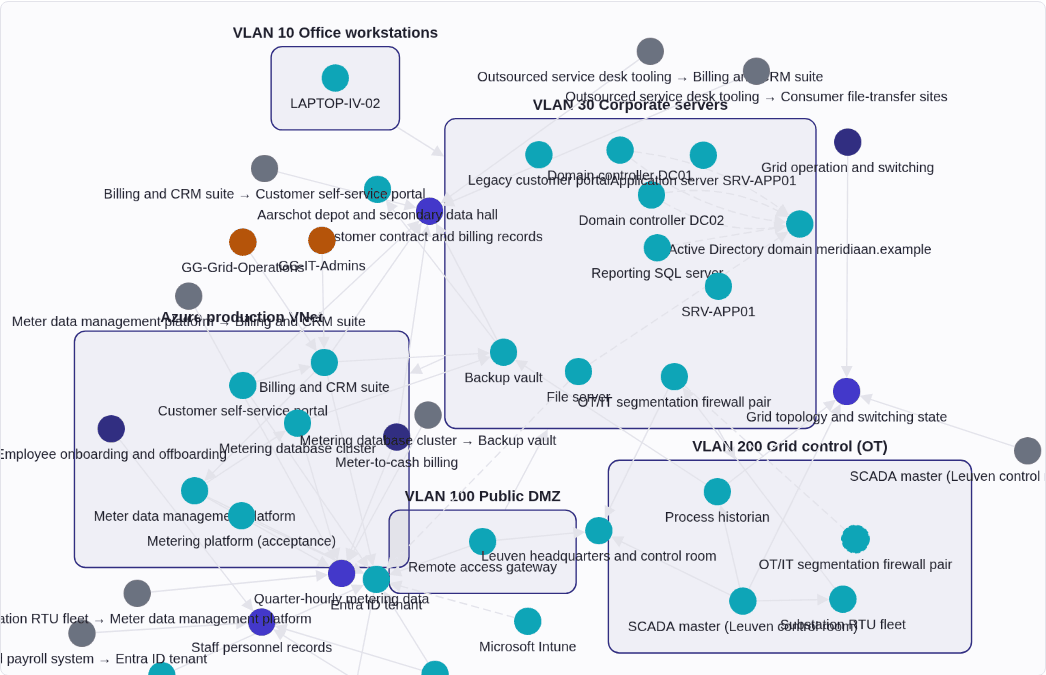
Everything links to everything, and the directory keeps it honest
A server links to the application it hosts. The application links to the risk it carries. The risk links to the control that treats it, and the control to the policy that requires it. Follow that chain from any record, in either direction, without cross-referencing a thing by hand.
The same links draw the topology graph and the data-flow diagrams, so a picture of your estate is never a picture of what your estate looked like the last time somebody redrew it.
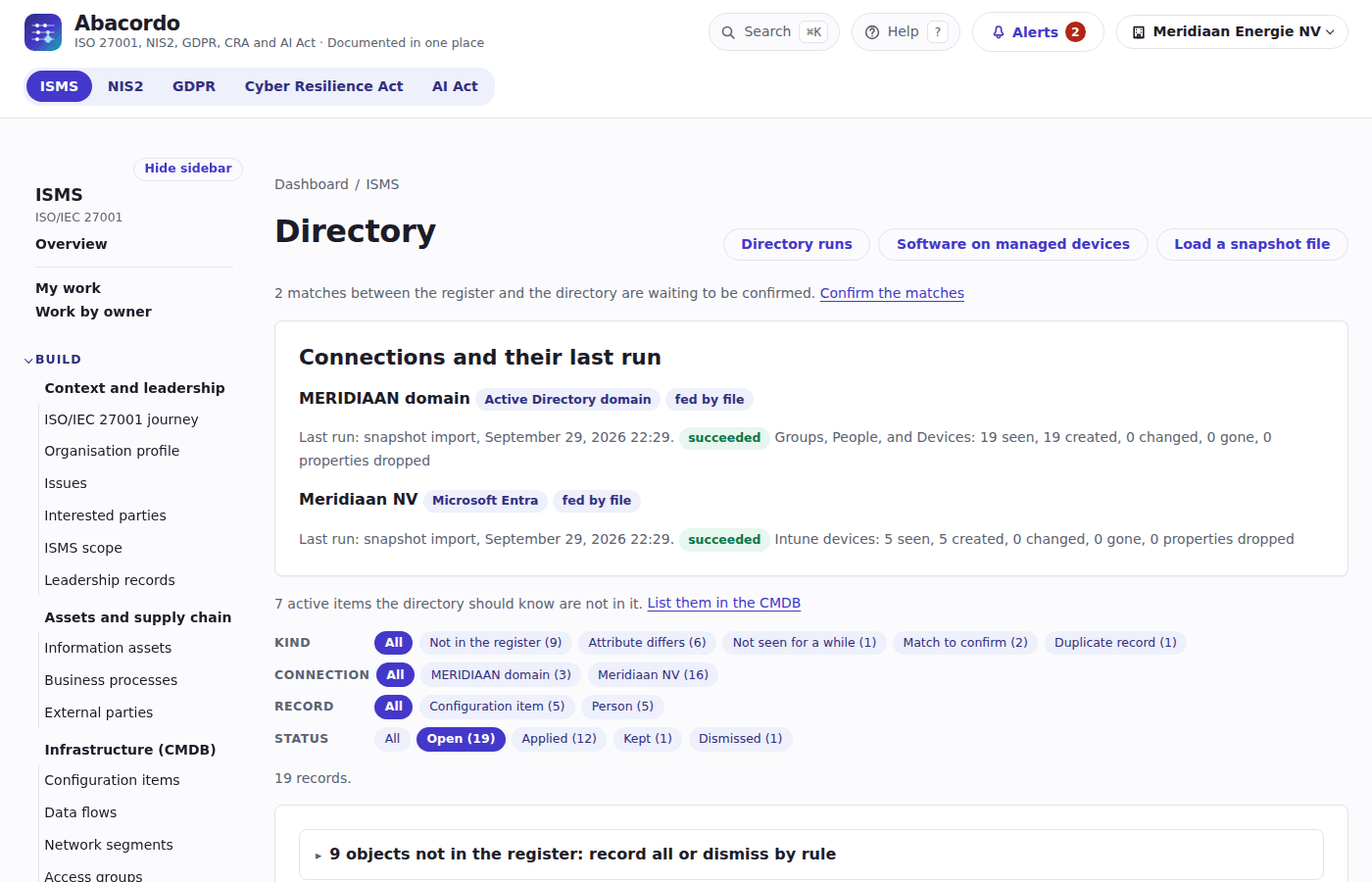
Read from Microsoft Entra, Intune and Active Directory
A CMDB typed in by hand goes stale the week it is finished. Connect Microsoft Entra and Intune live or by a snapshot file, and an on-premises Active Directory domain by a snapshot file your own script exports, and Abacordo reads what the estate actually holds. It is one-way: Abacordo holds read permissions only and never writes to your directory.
What the directory and your registers disagree about lands in one queue, answered in place: record it, match it to what you already have, take the directory's value, keep yours with a reason, or retire it. Managed devices are linked to the people who hold them. A group that reaches a system is listed on that system, with the purpose and approval you record against it. When somebody's account goes, their record offers the leaver's checklist. And a fact the whole estate answers in full, every managed laptop reporting an encrypted disk for instance, counts on the control that asks for it without a link drawn by hand.
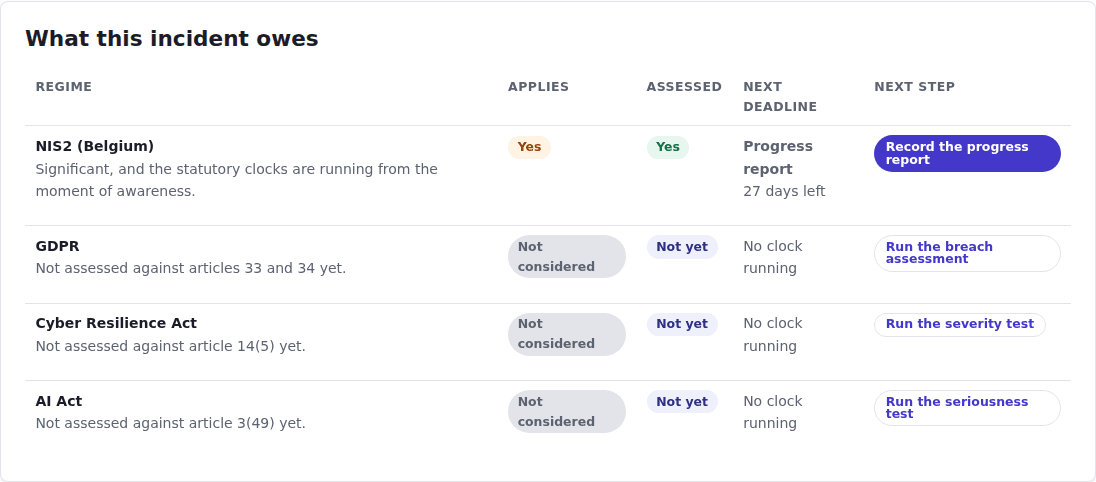
Incidents and notification
One incident, four regimes, one record
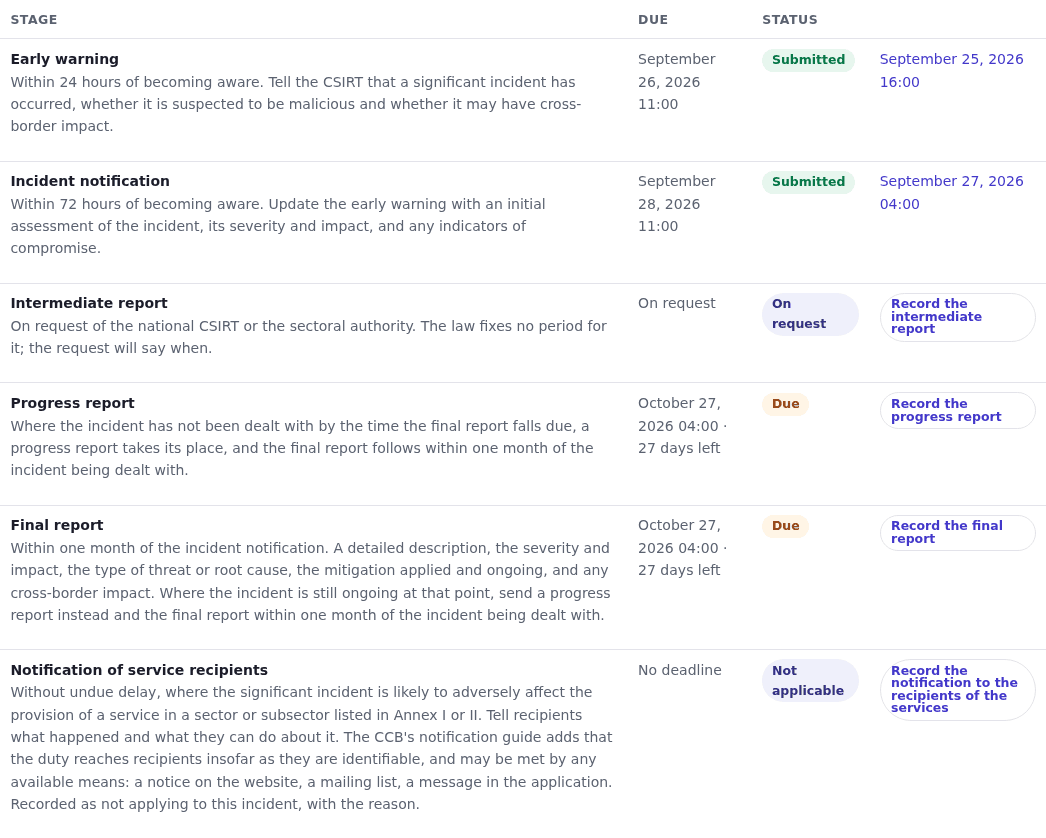
A single break-in can be a significant incident under NIS2, a personal data breach under the GDPR, a severe incident affecting a product under the Cyber Resilience Act and a serious incident involving an AI system under the AI Act, all at the same moment. Each regime has its own moment of awareness, its own authority and its own clocks. Abacordo runs them all from the one record and says what the incident owes under each, and what it needs from you next.
NIS2 asks for an early warning within 24 hours of your becoming aware, an incident notification within 72 hours (24 for a trust service provider), and a final report no later than a month after that notification, or a month after the incident is handled if it is still running then. The GDPR gives 72 hours from awareness to notify the supervisory authority. The CRA runs the same 24 hours and 72 hours for a severe incident affecting a product, with a final report a month after the notification. The AI Act's article 73 gives the provider of a high-risk AI system 15 days from awareness, shortened to 10 where a person has died and to two for a widespread infringement or a serious and irreversible disruption of critical infrastructure.
Every one of those is a latest date, not a target. NIS2, the GDPR and the CRA ask for notification without undue delay, and the AI Act for a report immediately once the provider has established a causal link, so the window is not a period to wait out. A GDPR notification that misses the 72 hours is still owed, with the reasons for the delay.
Abacordo does not file anything on your behalf. You notify through the channel each regime names and record here what you sent and when, which is what makes it provable a year later.
Risk
Your risk method, not ours
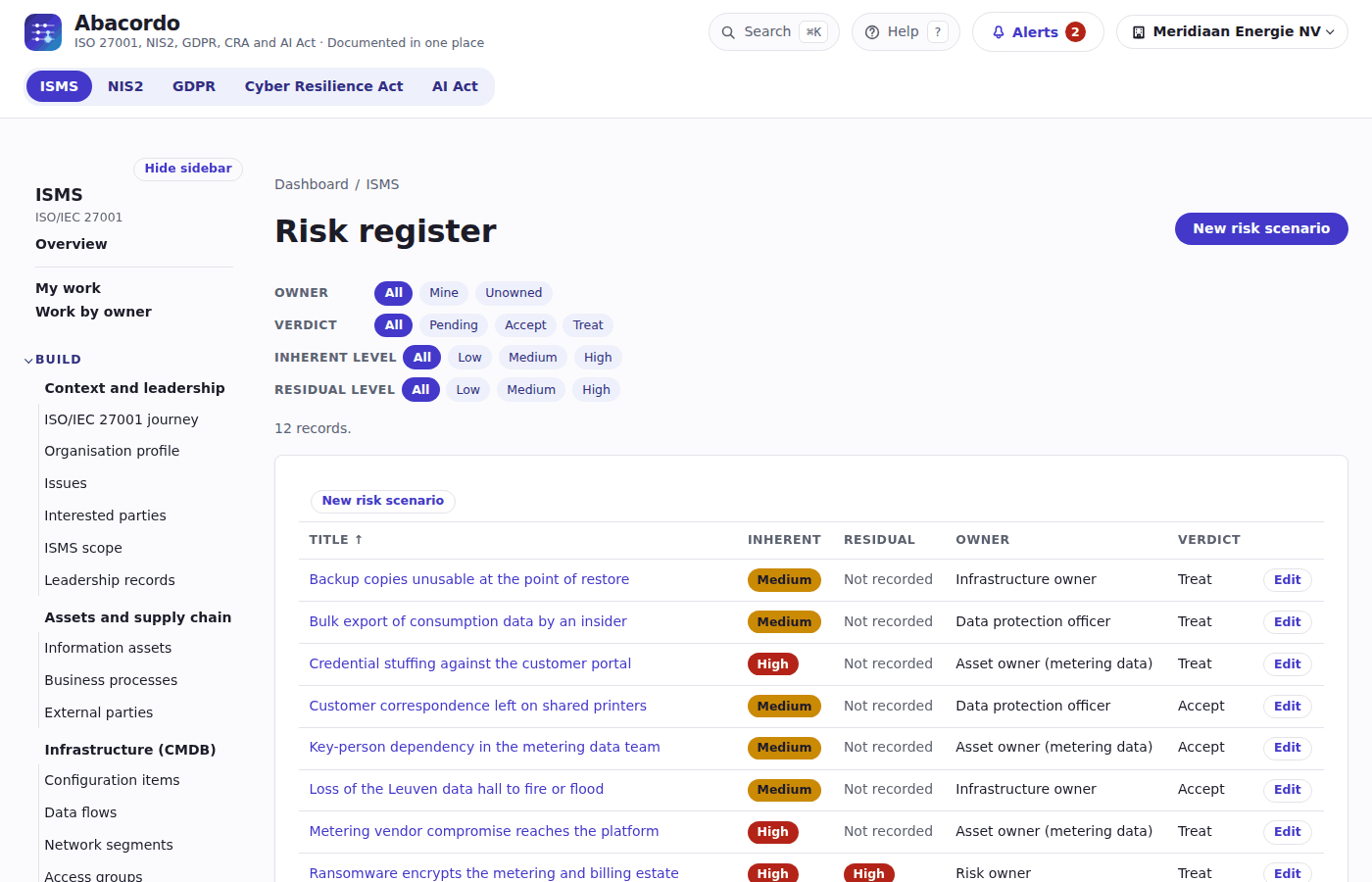
Qualitative, semi-quantitative or quantitative, your own scales, your own matrix bands. A new organisation starts on scales modelled on the ISO/IEC 27005 examples and a three-colour matrix so there is something to work with on day one, and changes any of it afterwards. Nothing in the engine is fixed, so you are not re-teaching your organisation somebody else's method.
The same register holds the risks a data protection impact assessment weighs, scored on a data-subject scale of their own, and the cybersecurity risks of a product you place on the market, so a risk is written once and read by the framework that asks about it.
Evidence, files and the audit trail
Nobody has to take your word for it
Changes to your records are attributed: who made each one, and when. An auditor reads the history rather than a summary of it, and when they ask for the whole management system, it exports as one package rather than as an afternoon of copying things into a folder.
A record carries the files it rests on: the CCB's confirmation on the entity profile, the signed processing agreement on a supplier, the certificate on a training record, the forensic report on an incident. They are streamed behind the record's own permissions and never sit at a public address.
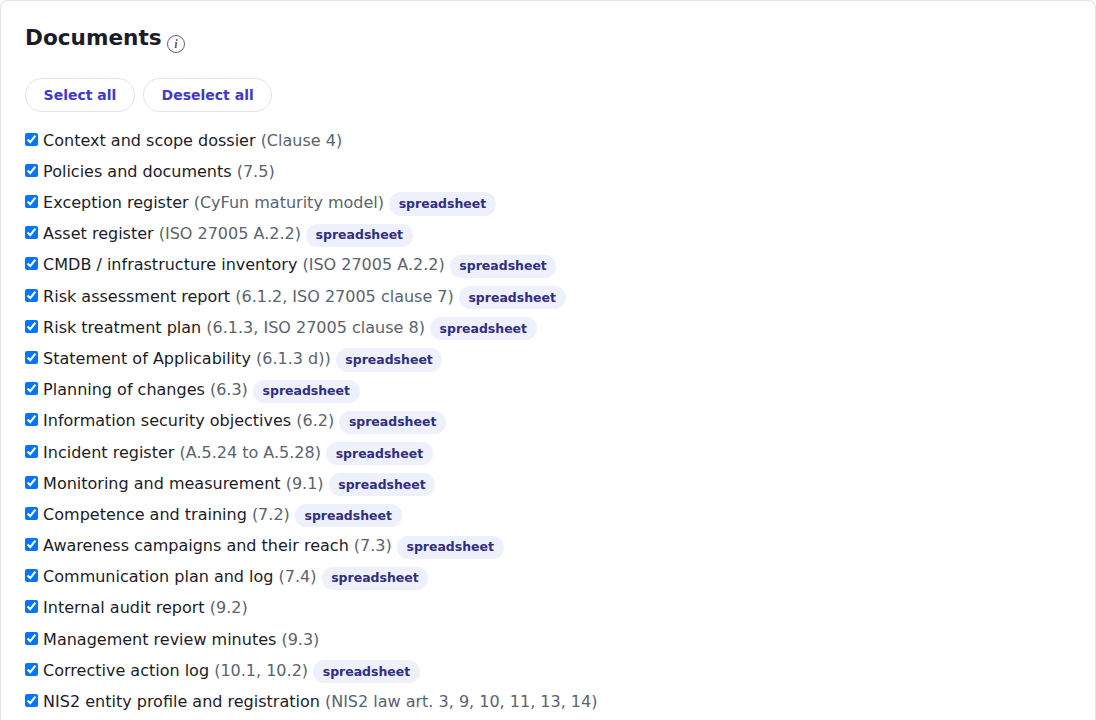
The export is one combined PDF, a ZIP of separate documents with an index, a spreadsheet of the registers or a Word document: the Statement of Applicability, the risk assessment report and treatment plan, the operational registers, the NIS2 evidence package a conformity assessment body reads, and the technical documentation and declaration of conformity of the CRA and of the AI Act. The register documents name what the clause asks for and your records do not yet say, so you see the gaps before an auditor does.
Closed beta
Request access to the closed beta
There is no self-service sign-up yet. We are taking on a small number of organisations at a time, so that each one is set up properly, frameworks chosen and directory connected, rather than left to work it out. Tell us who you are and we will come back to you.